 By
It is just before noon on the Rozenhoedkaai in Bruges, and the quay that was empty at breakfast is now three deep in people holding phones over the railing. Coaches have unloaded on the edge of town, the canal boats have queues, and the waffle smell is coming from every direction. A short train ride away, Ghent is going about its day with students on bikes, trams rattling past medieval guildhalls and locals eating lunch on the canal steps.
The two cities sit close together in Flanders, the Dutch-speaking north of Belgium, and most visitors from the UK try to see both in a single trip. They share canals, Gothic towers and a beer culture, but they feel very different, and where you sleep decides how much you enjoy them.
Ghent or Bruges: how to split your time
The short version: Bruges is a beautifully preserved small city that is at its best early in the morning and in the evening, and Ghent is a larger, working, university city that is lively at all hours. Both are walkable, and the train between them is short, so the real choice is where you sleep.
Why staying overnight in Bruges changes everything
Bruges receives a huge number of day visitors on coach tours, river cruise excursions and rail day trips from Brussels. They tend to arrive mid-morning and leave by late afternoon, so the centre is busiest from late morning to mid-afternoon. If you only ever see Bruges in that window, you see it at its most crowded. Stay a night and you get empty lanes first thing, lamplit canals after dark and a Markt with room to breathe.
Why Ghent makes a good base
Ghent has more going on in the evenings, a wider choice of places to eat and drink and a student population that keeps it from feeling like a museum. It sits on the main rail line between Brussels and Bruges, so a day trip is easy. The trade-off is that you then see Bruges in the busy middle of the day, unless you catch an early train.
Three ways to split a trip
- Two nights: one night in each. Arrive in Ghent, spend the afternoon and evening there, take the train to Bruges the next morning, and wake up in Bruges on the last day before heading home.
- Three nights: two nights in Ghent and one in Bruges, or the reverse if you prefer quiet evenings to a lively bar scene. Use the spare day for Damme by bike or for museums.
- A long weekend from one base: sleep in Ghent and catch an early train to Bruges, arriving before the coaches. See the Markt, the Burg and the canals first, then do the Begijnhof and the museums while the crowds peak.
Whichever you choose, avoid trying to do both cities in a single day., which means seeing each at its busiest.
Getting there from the UK
By train
The high-speed train from London St Pancras runs through the Channel Tunnel to Brussels-South (Brussels-Midi), where Belgian domestic trains continue to Ghent and Bruges. Some through tickets from London include onward travel to any Belgian station, so check the options when you book rather than buying a separate ticket at Brussels.
Ghent's main station, Gent-Sint-Pieters, is south of the centre, and a tram or a fairly long walk takes you into the old town. Bruges station is just outside the old ring, a walk of around a quarter of an hour to the Markt, or a short bus ride.
By ferry or tunnel with a car
Driving suits anyone bringing bikes. Take a ferry from Dover to Calais or Dunkirk, or the car shuttle through the Channel Tunnel, then the coastal motorway east into Belgium. Two things to know:
- Car-free centres: Ghent's centre is closed to through traffic and split into zones you cannot drive between, and Bruges restricts traffic inside its ring. Plan to park once, ideally at a park-and-ride or a large car park, and leave the car there.
- Low emission zone: Ghent has a low emission zone, and foreign vehicles may need to be registered before entering. Rules and penalties change, so check the official city website before you drive in.
If Ghent and Bruges are one stop on a bigger rail trip, The Ultimate Guide to Travelling Around Europe covers how to link cities across the continent.
Ghent: towers, guildhalls and the Mystic Lamb
Ghent's skyline is famous for three towers standing in a line: St Nicholas' Church, the Belfry and St Bavo's Cathedral. The classic place to see them together is St Michael's Bridge (Sint-Michielsbrug), which is also a good spot to get your bearings on the first afternoon.
Graslei and Korenlei
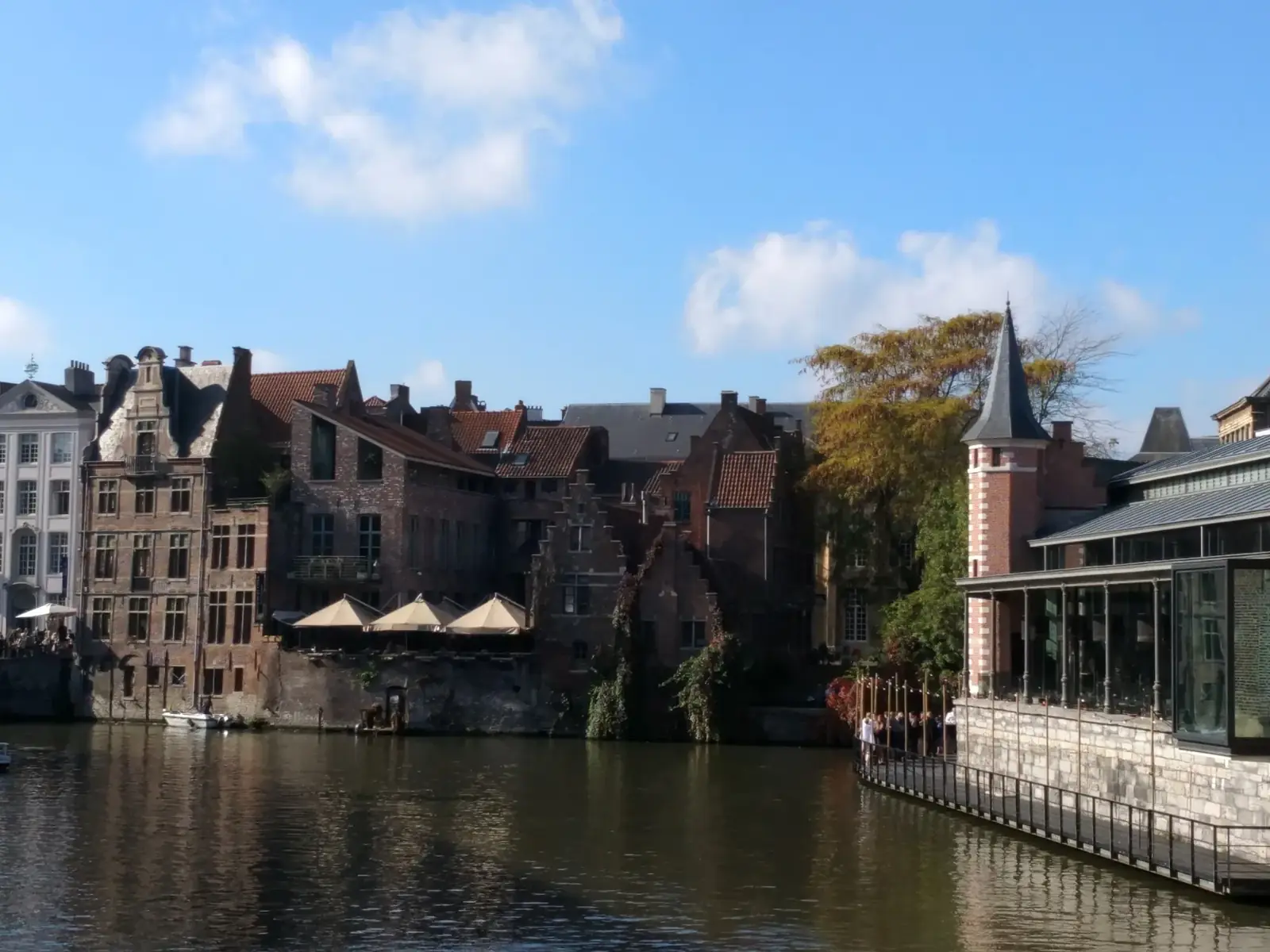
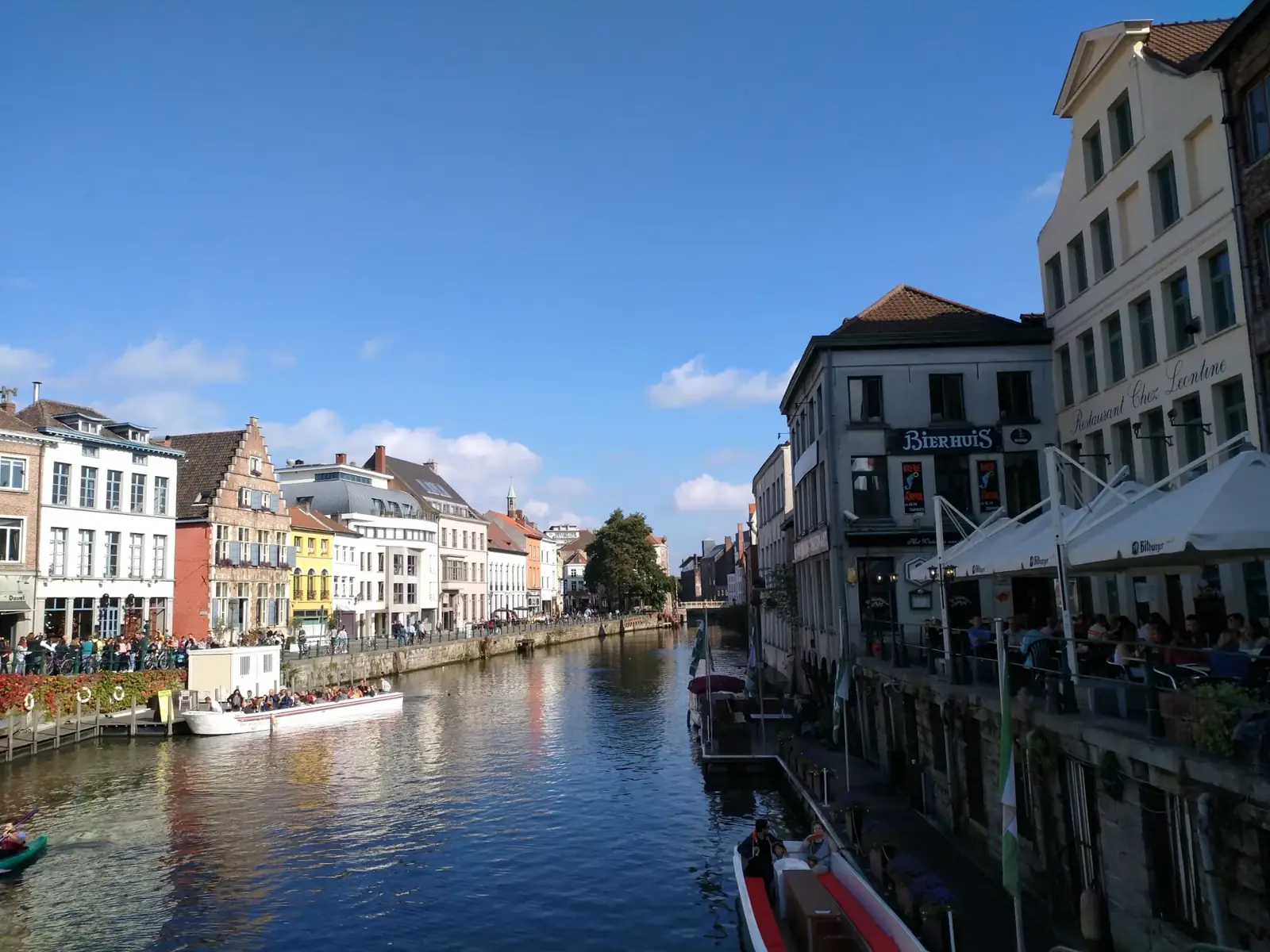
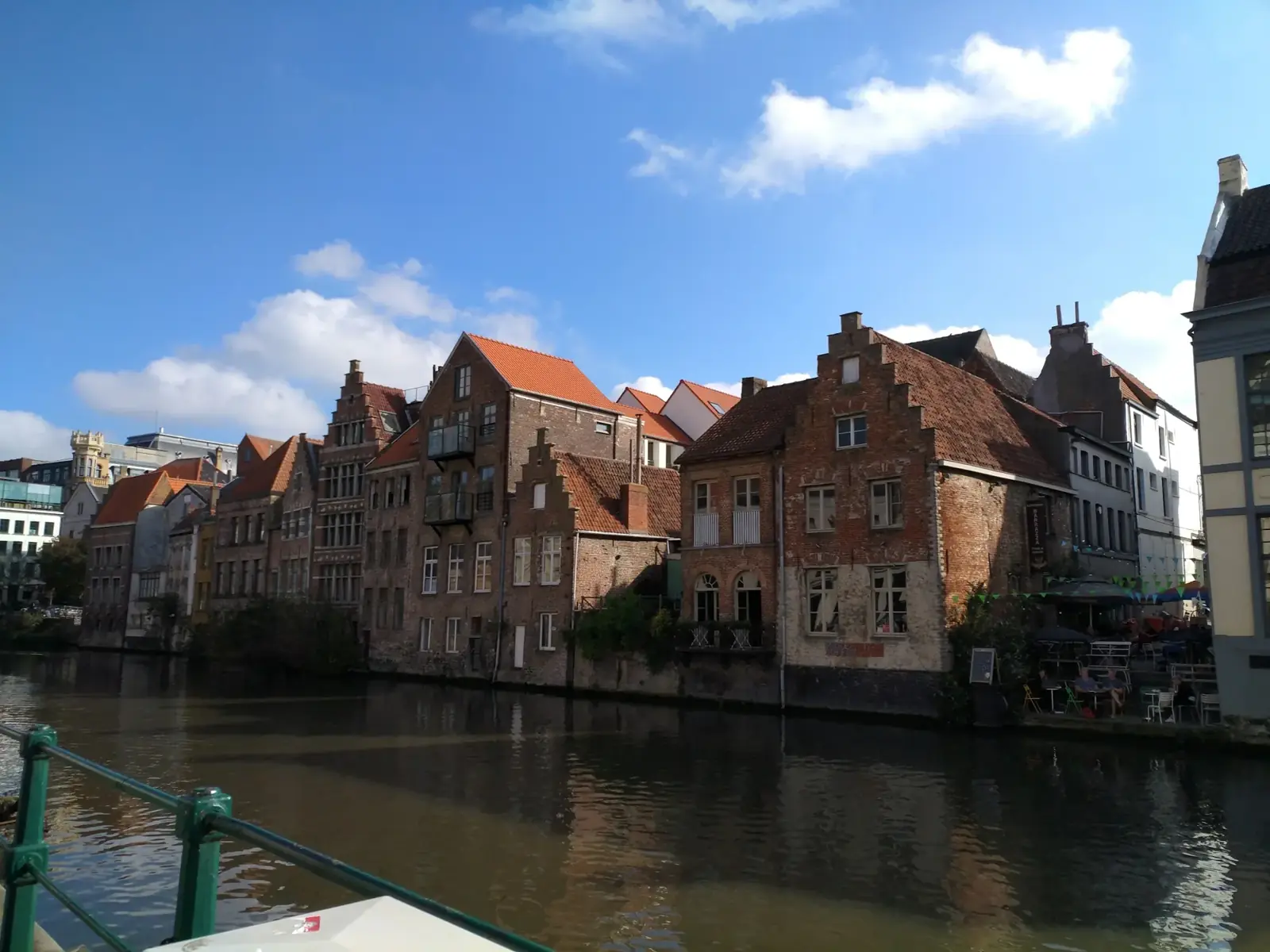
Below the bridge, the river Leie is lined on both banks by the old harbour quays. The Graslei and the Korenlei face each other across the water, with tall stepped-gable guildhalls and merchants' houses that once handled the grain trade. In good weather people sit along the quay edges with drinks. Walk both sides, because each gives the view of the other.
Gravensteen
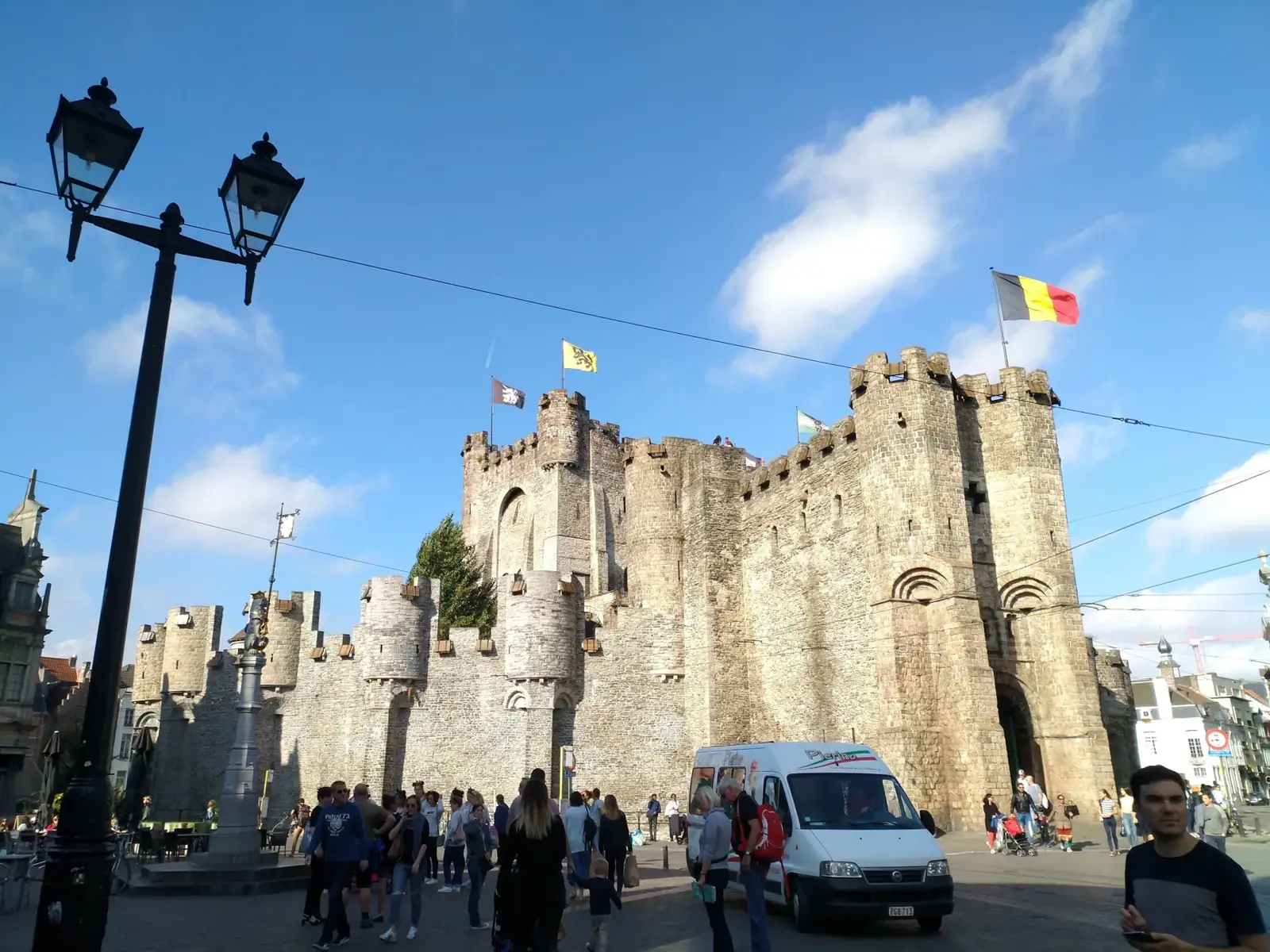
A few minutes north, the Gravensteen, the Castle of the Counts, rises straight out of the water. It is a stone fortress with a moat, a gatehouse and battlements, built for the Counts of Flanders and later used as a court and prison. Inside there is a display of weapons and instruments of punishment, but the main reward is the walk along the ramparts and the view over the rooftops. Visit early, because the narrow stairs and passages clog up quickly.
St Bavo's Cathedral and the Ghent Altarpiece
St Bavo's Cathedral holds the city's great treasure: the Ghent Altarpiece, also known as the Adoration of the Mystic Lamb, painted by the brothers Hubert and Jan van Eyck. Its central panel shows a lamb on an altar surrounded by saints, pilgrims and angels in minutely detailed landscape. It has been looted and hidden over the centuries, and one panel, the Just Judges, was stolen in the last century and never recovered; the one in place is a copy.
The altarpiece is shown in a dedicated space within the cathedral with its own ticket and an introductory visitor route. Book a time slot ahead on the official website, especially at weekends, and check the current arrangements, because they change. The rest of the cathedral, with its Baroque pulpit and crypt, is worth time too.
The Belfry and St Nicholas' Church
Between the cathedral and the Graslei stands the Belfry (Belfort), the civic tower that once held the city's charters and its bells, with a gilded dragon on top. The belfries of Flanders are listed together by UNESCO, and climbing this one gives a wide view over the three-tower skyline from inside it.
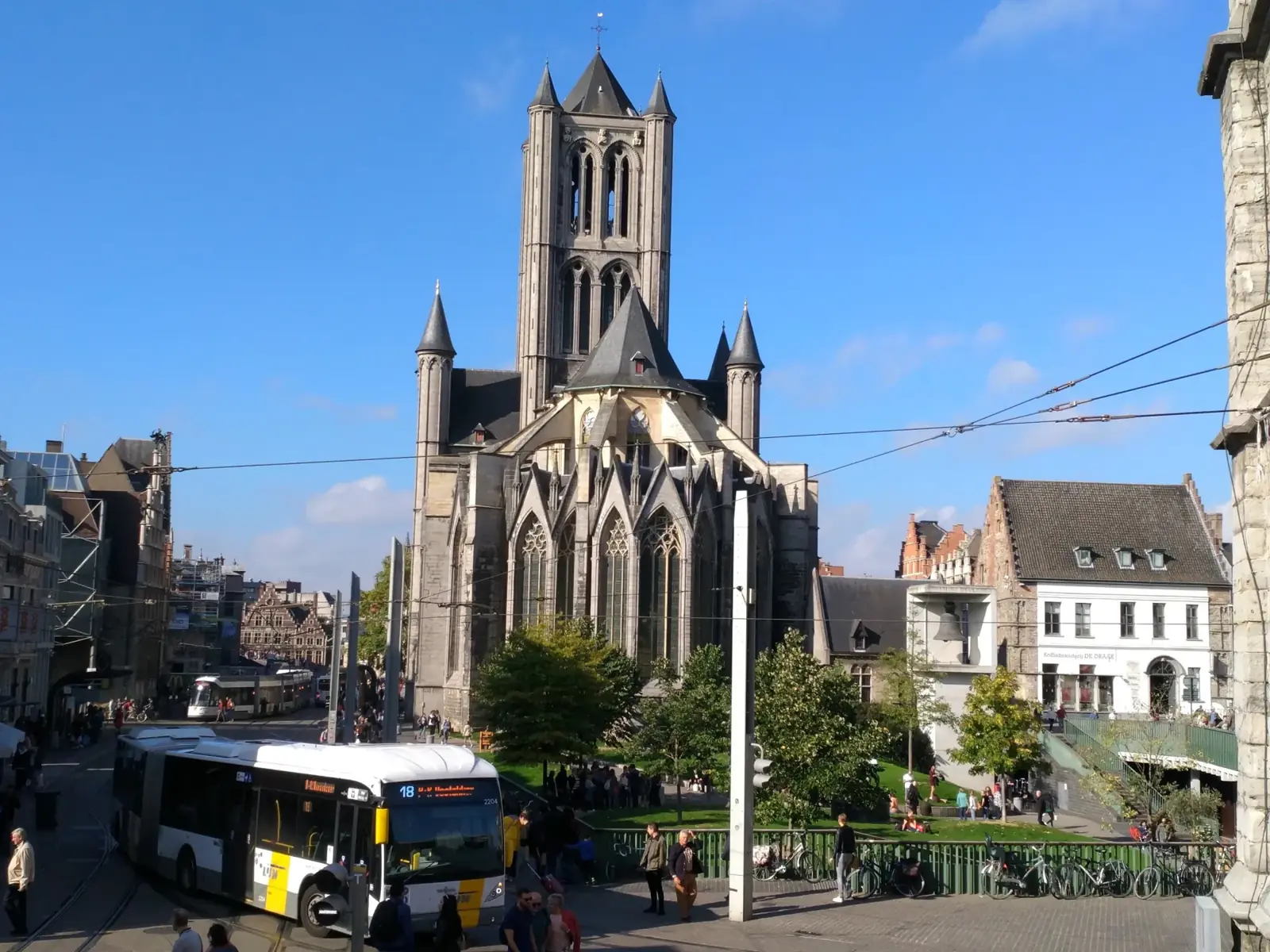
Next door, St Nicholas' Church is a tall church in grey-blue stone in a style known as Scheldt Gothic, after the river that carried the stone to the city. Its lantern tower over the crossing is unusual, and the interior is light and spacious. It is free to enter in normal circumstances and usually much quieter than the cathedral.
Ghent's neighbourhoods and evenings
Patershol
Just behind the Gravensteen, Patershol is a small district of narrow cobbled lanes, low brick houses and tiny squares. Once a run-down quarter, it is now full of small restaurants and a good area for traditional Flemish cooking.
Vrijdagmarkt and the old markets
The Vrijdagmarkt is a large square ringed by guildhouses and bars, with a statue of Jacob van Artevelde, a medieval Ghent leader, in the centre. A market is held here and the square fills with terraces in the evening. Nearby, the Groentenmarkt, the old vegetable market, is where you will usually find the cuberdon sellers and a cluster of places to eat.
The student city at night
Ghent's large university gives the city a long, informal evening life, with student cafés clustered south of the centre. A public lighting plan illuminates its towers, bridges and quays after dark, so a late walk along the Graslei costs nothing and is a highlight. If you like street art, the narrow Werregarenstraat alley, where graffiti is permitted and constantly repainted, is a short walk from the Belfry.
Summer brings the Gentse Feesten, a long city festival of street music and theatre. It is a great time to be in Ghent if you want a party, and a poor time if you want quiet streets or a cheap room.
Canal boats in Ghent
Short boat trips leave from the Graslei and Korenlei area and loop through the old harbour, under the bridges and past the Gravensteen. Boats are open-topped, so take a waterproof.
Bruges: the Markt, the Burg and the canals
The whole historic centre of Bruges is listed by UNESCO, and it is compact enough to cross on foot in well under an hour. The heart of it is two squares a short walk apart.
The Markt and the Belfort
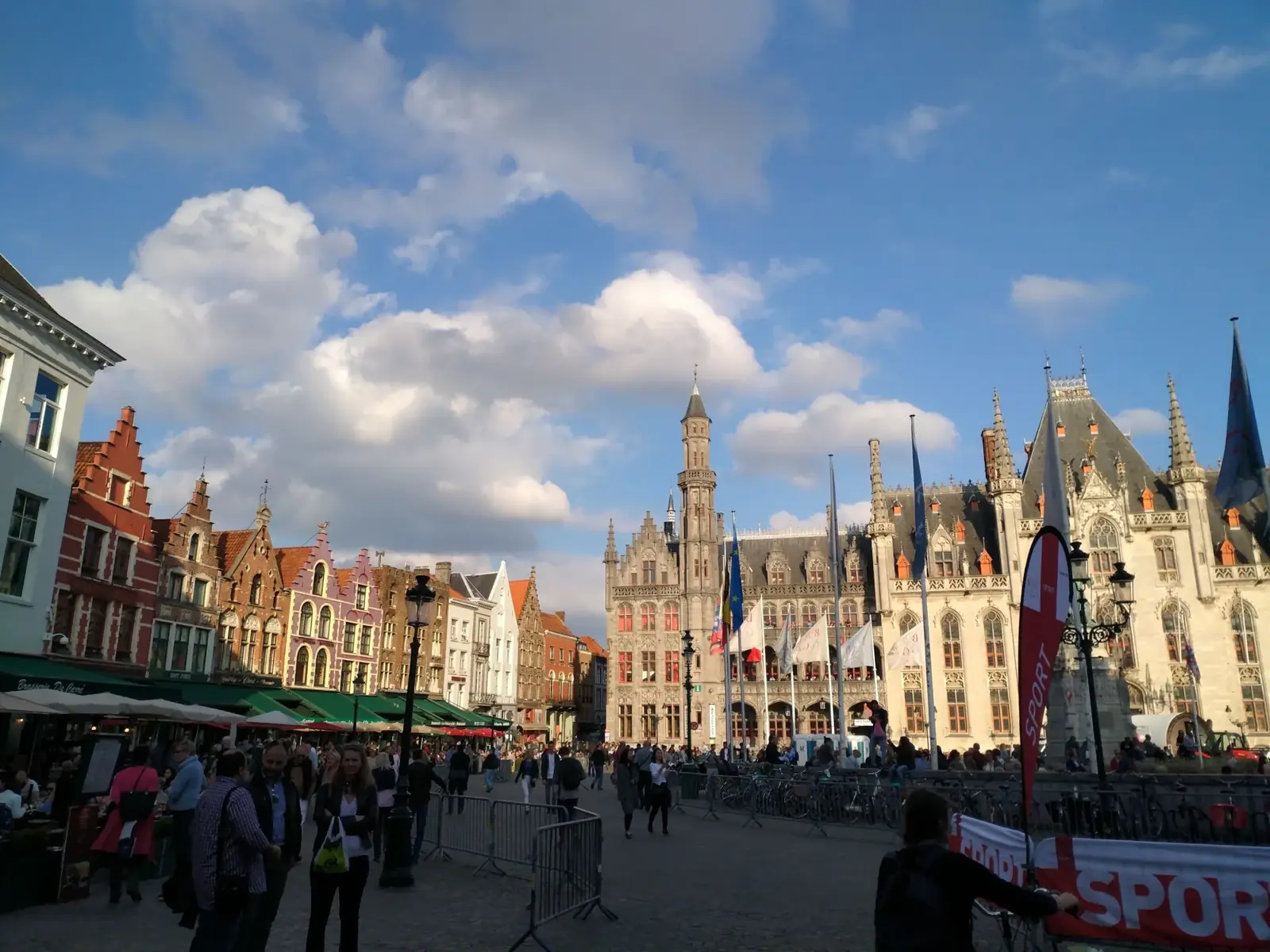
The Markt is the big open square at the centre, lined with brick houses with stepped gables and dominated by the Belfort, the belfry tower that leans very slightly. In the middle is a statue of Jan Breydel and Pieter de Coninck, leaders of a medieval Flemish uprising, and on one side is the neo-Gothic Provincial Court. Horse-drawn carriages wait here, but cobbles and summer heat are hard on horses and their welfare is a long-running local debate, so you may prefer to see the city on foot or by boat.
The climb up the Belfort is on narrow, steep stairs, past the treasury and the carillon, a set of bells played from a keyboard, to a view over the red roofs. Numbers inside are limited at any one time, so queues build quickly. Go at opening time or late in the day, and check the official website for current ticketing.
The Burg
Through a lane from the Markt, the Burg is smaller and more ornate. Its City Hall (Stadhuis) has an elaborate Gothic façade lined with statues, and its Gothic Hall upstairs has a painted and carved ceiling. In one corner, the Basilica of the Holy Blood is a two-level chapel: a dim Romanesque lower church and a richly decorated upper chapel that holds a relic venerated by Catholics. It is a place of worship, so keep voices down and dress respectfully.
The Rozenhoedkaai and the canals
South of the Burg, the Rozenhoedkaai is the corner of quay where canals meet beneath old houses with the Belfort rising behind them. See it at dawn or after dark for the version without the crowds.
Canal boat trips leave from several landing stages in the centre and take a loop through the main canals, giving views of gardens and back walls you cannot reach on foot. Expect a queue in the middle of the day and a short, often crowded, trip.
Bruges beyond the postcard
The Begijnhof and Minnewater
The Begijnhof, the Beguinage, is a walled enclosure of white houses around a green, built for the beguines, lay religious women who lived in community without taking full vows. It is now home to a community of Benedictine nuns and other residents, and visitors are asked to keep silent. In spring the lawn is covered in daffodils. Just beyond it is Minnewater, often called the Lake of Love, a peaceful stretch of water and parkland at the southern edge of the old town.
Groeninge Museum and the Flemish Primitives
Bruges was a rich trading city in the late Middle Ages, and its painters left remarkable work. The Groeninge Museum is the place to see it, with paintings by Jan van Eyck, including the Madonna with Canon van der Paele, and by Hans Memling and Hieronymus Bosch. It is a compact museum and makes a good stop in the middle of the day when the streets are busiest. Nearby, the Church of Our Lady holds a marble Madonna and Child by Michelangelo, and its tall brick spire is visible across the city.
Cycling to Damme
A classic half-day out of Bruges is the ride to Damme, a small town to the north-east that was once the port for Bruges. The route follows a straight canal lined with tall poplar trees through flat countryside, and it is easy for anyone who can ride a bike. Damme has a Gothic town hall and a quiet main street, and bike hire is easy to find in Bruges, often from shops near the station and the Markt. Ride out in the morning and back after lunch, and take a waterproof, because there is little shelter on the way.
What to eat and drink in Ghent and Bruges
Flemish food is hearty, built for cold and wet weather, and best eaten slowly with a beer.
Dishes to look for
- Stoverij, called carbonade flamande in French, a beef stew cooked slowly in dark beer, often with bread spread with mustard, and served with frites.
- Waterzooi, a Ghent dish of creamy broth with vegetables, originally made with fish and now more often with chicken.
- Frites, fried twice and served in a paper cone from a frietkot, a chip stand. Mayonnaise is the default, but try andalouse, a spiced tomato mayonnaise, or a ladle of stew gravy.
- Ghent mustard, sharp and coarse, sold in stoneware jars.
Sweet things
There are two main kinds of waffle. The Brussels waffle is light, crisp and rectangular, usually eaten with a fork and toppings. The Liège waffle is denser, made with a dough that contains pearl sugar, which caramelises on the iron, and it is the one sold to eat in the street. A Liège waffle needs nothing on top.
Cuberdons are Ghent's own sweet: purple cone-shaped sweets with a hard crust and a soft, sticky raspberry-flavoured centre, known locally as neuzekes, little noses. They do not keep well, so eat them within a few weeks and do not pack them squashed at the bottom of a bag.
Both cities are full of chocolate shops. Belgian pralines, filled chocolates, are the classic purchase. Buy from shops that make their own and sell by weight, not pre-packed boxes.
How Belgian beer is served
Belgian beer culture is part of UNESCO's list of intangible heritage, and the way it is served is part of the experience. Each beer is poured into its own branded glass, shaped for that beer, often a chalice, a goblet or a tulip, so do not be surprised when the glass changes with every round.
- Trappist and abbey beers: dubbels and tripels, rich and often strong.
- Flemish red and brown ales: sour, fruity beers aged in wood, a regional speciality of West and East Flanders.
- Blond and golden ales: pale but frequently much stronger than they taste.
- Witbier: a cloudy wheat beer with spice and orange peel, lighter and easier on a hot afternoon.
The common mistake is treating a strong Belgian beer like a pint at home. Many are far stronger than a British ale and come in smaller measures for a reason. Sip, eat something, and alternate with water. Ghent is also known for jenever, a juniper spirit and ancestor of gin, served in small glasses filled to the brim.
Practicalities: cobbles, rain, bikes and crowds
Cobbles and footwear
Both centres are paved largely in cobbles, which are uneven, slippery when wet and hard on thin soles and wheels. Wear flat shoes with a good grip, and if you have a wheeled suitcase, expect a noisy walk from the station or take a taxi or bus.
Rain
Flanders is wet in every season, and showers come and go quickly. Pack a light waterproof rather than relying on an umbrella in the wind, and keep museums, churches and the Groeninge in reserve for a rainy spell.
Cycling and walking safely
Bikes are everywhere, and they are a real hazard for visitors on foot. Red or marked paths beside the road are cycle paths, not pavements, so look both ways before stepping onto one. If you ride:
- Keep to the right and use the cycle paths where they exist.
- Many one-way streets allow bikes in both directions, shown by a small sign under the no-entry symbol, so expect oncoming cyclists.
- In Ghent, some streets are marked as cycle streets, where cars may not overtake bikes.
- Cross tram tracks in Ghent at a sharp angle so your wheel cannot slip into the groove.
When the crowds peak
Bruges is busiest from late morning to mid-afternoon, at weekends and in the school holidays, and in the run-up to Christmas, when the markets draw large numbers. Ghent is busy during the Gentse Feesten and on summer weekends but rarely feels as packed. Weekdays outside the holidays are the calmest time for both.
If Flanders leaves you wanting more canals, 7 Things You Must Do When Visiting Amsterdam is a natural next trip by train.
Book the Mystic Lamb and the Belfort in advance, sleep at least one night in Bruges, and be on the Rozenhoedkaai before the first coach arrives.
Official sources and further reading
Opening times, entry rules and prices change, so check them on the official sites before you travel:
- Visit Gent (official): Ghent's official visitor site: sights, museum passes and events.
- Visit Bruges (official): Bruges' official visitor site: sights, canal boats and seasonal information.
- GOV.UK: Belgium travel advice: Entry requirements, safety and health advice for British travellers, kept up to date by the UK government.