 By
You arrive in Granada, walk up to the Alhambra ticket windows on a bright morning, and find a sign saying the palaces are sold out for the day. It happens all the time. The city itself is generous: drinks come with free food and the old Moorish quarter is a joy to wander. But the sight most people come for runs on a strict system, and it pays to understand it before you book a flight.
This guide starts with that system, then works outwards to the Albaicín, Sacromonte, the cathedral quarter, the tapas habit and the mountains beyond.
Why the Alhambra decides the whole trip
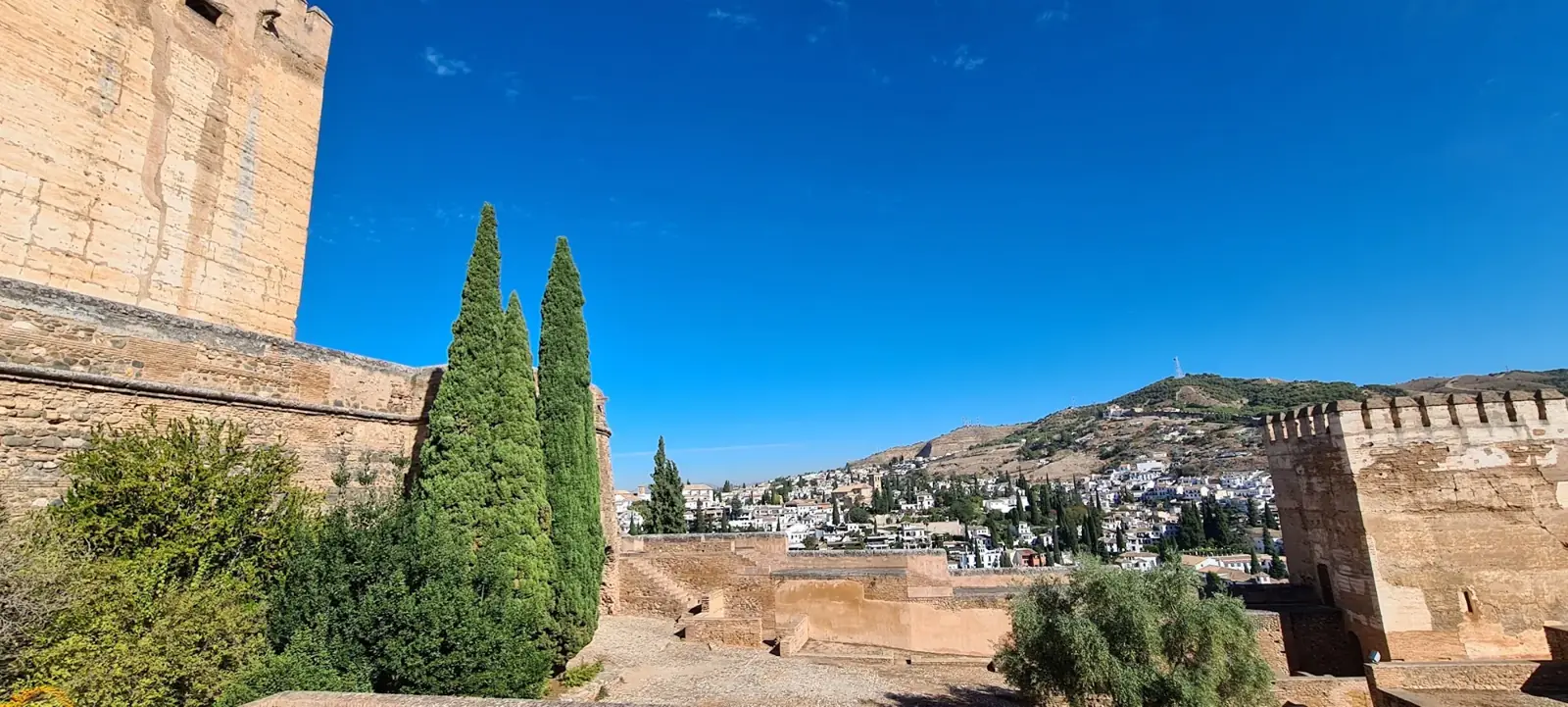
The Alhambra is a hilltop complex of palaces, fortifications and gardens built mainly under the Nasrid dynasty, the last Muslim rulers of Granada, and later reshaped by the Christian monarchs who took the city. Plan it first, before accommodation and train times.
The timed Nasrid Palaces slot
Most of the complex can be explored at your own pace once you are inside, but the Nasrid Palaces, the most famous part, run on a timed entry. Your ticket gives you a specific slot, and you need to be at the palace entrance for it. Arrive late and you can be refused entry to the palaces, even though the rest of your ticket is still valid. The palace entrance is a fair walk from the main ticket area, so allow plenty of time.
Build the rest of your visit around that slot: with an early slot, do the gardens and fortress afterwards; with a later one, see the Alcazaba and the Generalife first.
Booking: early, and only from official sources
Tickets for the full visit sell out well ahead, especially in spring, autumn and around holidays. Book as soon as your dates are fixed, through the official Alhambra ticketing website or its authorised channels only. Tickets are issued in the visitor's name, and staff can check identity documents at the entrance, so bring the passport or ID you booked with. Tickets from unofficial resellers may not get you in.
Ticket types, prices, quotas and opening times change, so check them on the official website. If the full ticket has gone, look at the options that remain: some tickets cover the gardens and fortress but not the Nasrid Palaces, and a separate night visit to parts of the complex is sometimes offered.
The classic mistakes: booking only on arrival, choosing a palace slot that clashes with a train, and assuming a gardens-only ticket includes the Nasrid Palaces. It does not.
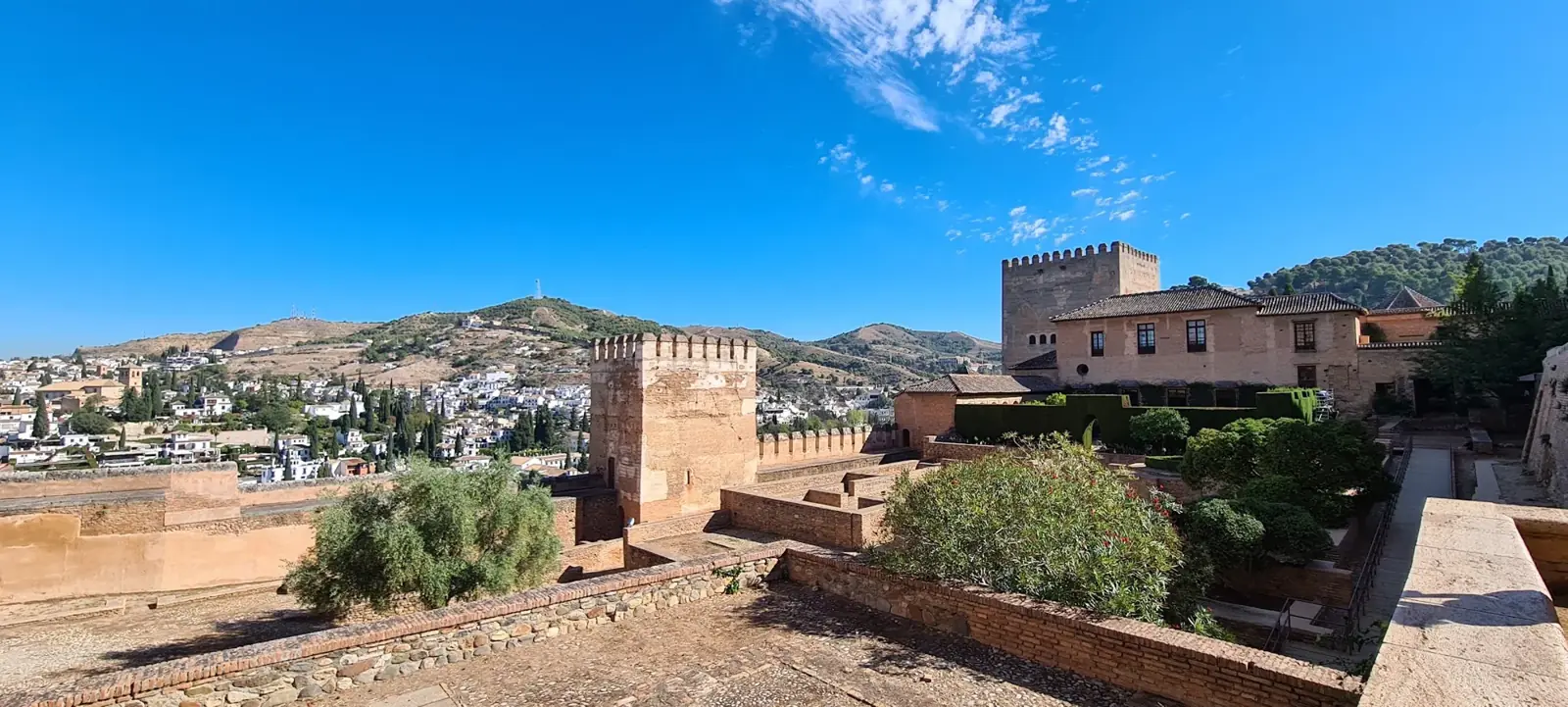
Inside the Alhambra: palaces, fortress and gardens
A full visit takes most of a morning or an afternoon, and many visitors happily spend longer. Wear comfortable shoes, carry water, and expect a lot of walking on gravel paths and uneven stone.
The Nasrid Palaces
This is the part that ends up on every postcard. You move through a sequence of rooms and courtyards: the Mexuar, where the sultans held audiences, then the Comares Palace, with the long reflecting pool of the Court of the Myrtles and the domed Hall of the Ambassadors, and finally the Palace of the Lions, built around the famous fountain held up by stone lions. Look up as much as around you. The carved plaster, the honeycomb muqarnas ceilings and the Arabic inscriptions running along the walls are what make these rooms extraordinary. The route is one-way and can feel busy, so pause in the doorways and let groups pass.
The Alcazaba
The Alcazaba is the military heart of the hill and the most rugged part of the complex. It is mostly walls, towers and the outlines of soldiers' quarters, so it impresses through its position rather than its decoration. Climb the Torre de la Vela for a wide view over the city, the Albaicín opposite and, on a clear day, the Sierra Nevada.
The Palace of Charles V
In the middle of the complex stands the Palace of Charles V, a Renaissance building that looks startlingly out of place: square from the outside, with a perfectly circular courtyard inside. It was built for the emperor after the Christian conquest and houses the Alhambra Museum, with Nasrid-era objects, and the Museum of Fine Arts.
The Generalife
The Generalife was the sultans' summer retreat, set on a slope above the main palaces. Its gardens are terraces of hedges, flowerbeds, cypresses and water, and the long pool of the Patio de la Acequia, lined with fountains, is the image most people remember. After the density of the palaces, this is where the Alhambra breathes.
Getting up the hill
The Alhambra sits well above the city centre. The classic walk starts at Plaza Nueva and climbs the Cuesta de Gomérez, through the Puerta de las Granadas and up through the shaded woods that cover the hillside. It is steep but shaded. Small city buses and taxis also run up from the centre, and many visitors ride up and walk down, which is the easier way round.
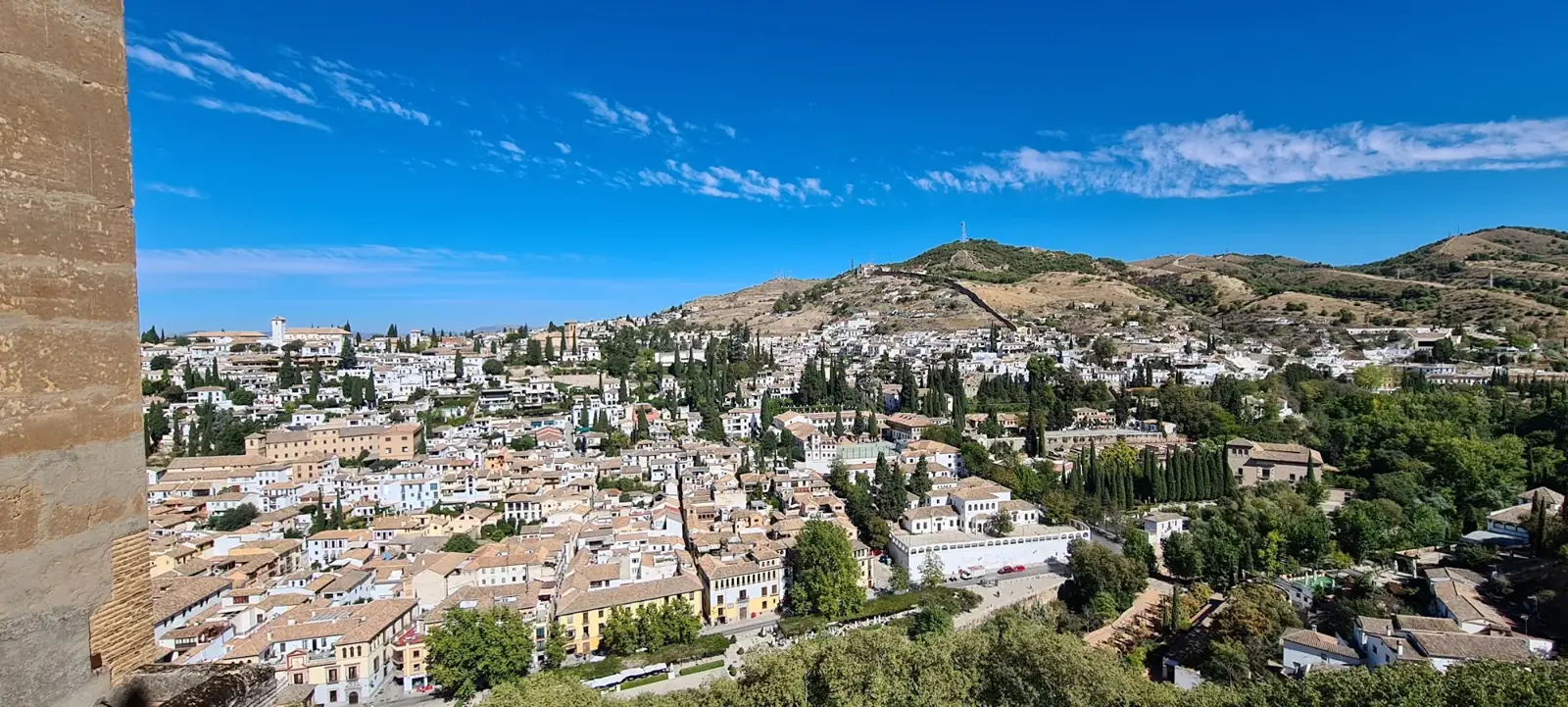
The Albaicín: lanes, carmens and the famous sunset
Across the narrow valley of the river Darro, facing the Alhambra, rises the Albaicín, the old Moorish quarter. It is a hillside maze of steep cobbled lanes, whitewashed walls, small squares and staircases, and it shares World Heritage status with the Alhambra. Getting lost is part of the point, but keep a map handy for the way back.
Carmens and quiet corners
Behind many of the high white walls are carmens, traditional Granada houses with walled gardens of fruit trees, vines and fountains, usually facing the Alhambra. Some carmens have been turned into museums, gardens or restaurants with terraces, which is the easiest way to see inside one. Most others are private homes.
Wander up towards Plaza Larga, a neighbourhood square with a morning market feel, and through the Arco de las Pesas, one of the old gates in the quarter's walls. The upper Albaicín is much quieter than the lanes nearest the centre and gives a better sense of everyday life.
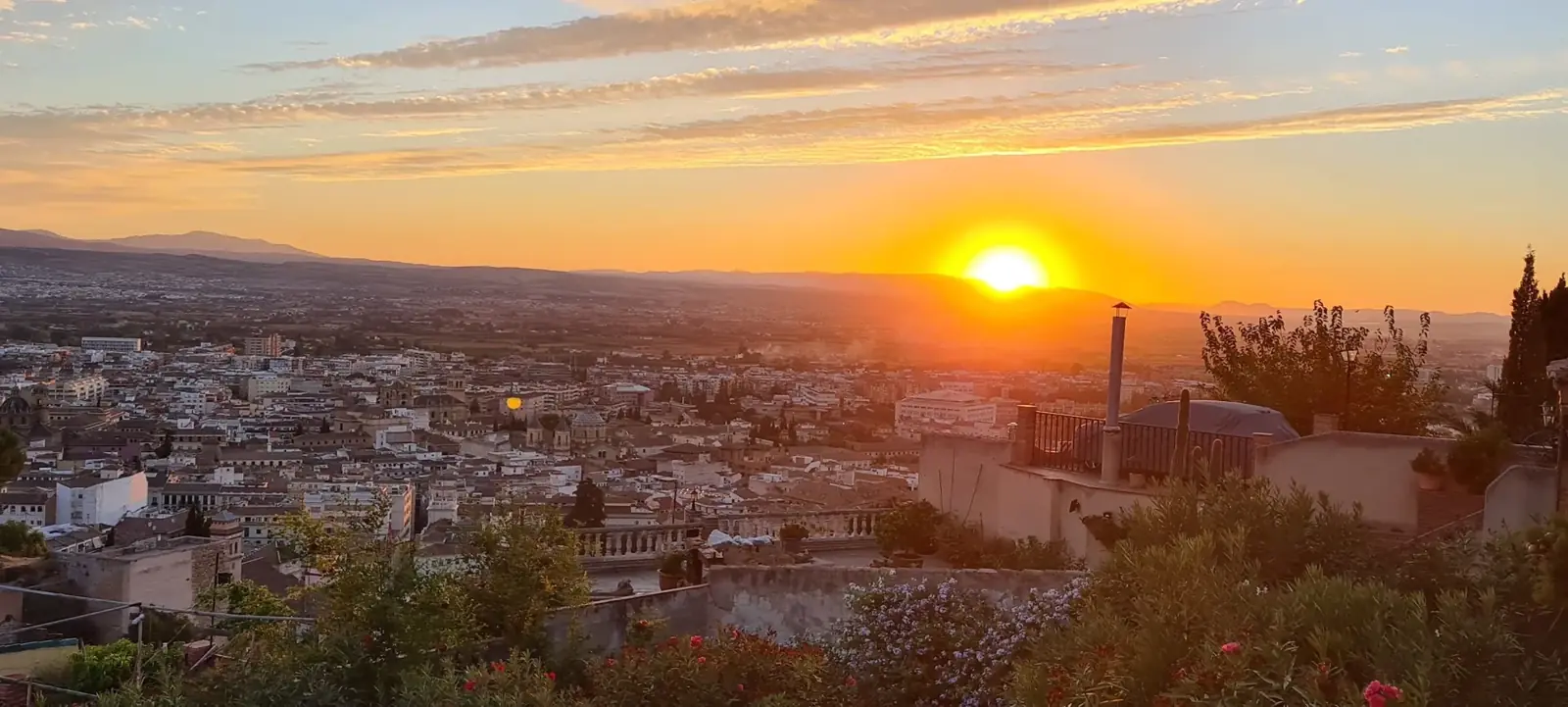
Mirador de San Nicolás at sunset
The Mirador de San Nicolás, the terrace beside the church of San Nicolás, has the view that made the Alhambra famous: the red walls and towers on their ridge, with the Sierra Nevada behind. At sunset the stone turns orange and then pink, and the terrace fills with visitors, musicians and street sellers. It is worth seeing, but go early to find a spot on the wall, and keep your bag in front of you, because crowds like this attract pickpockets. If it is too packed, the Mirador de San Cristóbal, higher up on the edge of the quarter, gives a wider and usually calmer view over the city and the Alhambra.
Carrera del Darro and Paseo de los Tristes
At the bottom of the hill, the Carrera del Darro runs along the river from Plaza Nueva, with small stone bridges, old houses and church façades on one side and the Alhambra woods rising on the other. Along the way is El Bañuelo, a well-preserved Arab bathhouse that is easy to miss. The street opens out into the Paseo de los Tristes, a terraced riverside promenade right below the Alhambra walls. It is at its best in the evening, when the fortress is lit up above you. Walking up through the Albaicín and down via the Carrera del Darro makes a natural loop.
Sacromonte: cave houses and flamenco
Beyond the Albaicín, the hillside of Sacromonte is dotted with cave houses dug into the slope, their whitewashed fronts and chimneys poking out of the prickly pear and scrub. For centuries this has been home to Granada's Gitano community, and it is closely tied to the city's own style of flamenco.
Understanding the caves
Some caves are still lived in, others have become bars, guesthouses or performance spaces. To understand how they worked, visit the Sacromonte Caves Museum, an interpretation centre in a group of restored caves higher up the hill, which explains cave life, crafts and the local landscape. It is a steep walk, so go in the cooler part of the day. Further up again is the Abbey of Sacromonte, with good views back over the valley.
Flamenco in the caves
Granada's traditional form is the zambra, a flamenco style performed in the caves, often with the audience sitting along the walls just a few steps from the dancers. Shows range from heartfelt performances by local families to polished productions aimed squarely at tour groups. Signs of a better evening include named performers, a small room, a modest audience and no hard selling on the street. Shows usually start late, so eat first, and agree how you will get back afterwards, as the lanes are dark and steep.
The lower town: cathedral, Royal Chapel and the Alcaicería
Down on the flat, around the cathedral, Granada feels like a busy Spanish city again, with shopping streets, squares and traffic. The main sights are close together and fit into half a day.
The cathedral
Granada Cathedral was built after the Christian conquest, on the site of the main mosque. It is a bright, white Renaissance interior, very different from the dark Gothic cathedrals of northern Spain, with tall columns and a richly decorated main chapel.
The Royal Chapel
Next door, and entered separately, is the Royal Chapel, the Capilla Real. This is where the Catholic Monarchs, Ferdinand and Isabella, chose to be buried, in the city whose conquest completed their campaign. Their marble tombs lie side by side, with their daughter Joanna and her husband Philip nearby, and the plain lead coffins can be seen in the crypt below. For anyone interested in Spanish history, this is more moving than the cathedral itself. Check opening times on the official sites, as both buildings have services and can close at short notice.
The Alcaicería and around
Between the cathedral and the main street, the Alcaicería is a tight cluster of alleys that was once the Moorish silk market. It burned down and was rebuilt in a romantic Moorish style, and today it is lined with stalls selling lamps, ceramics, textiles and souvenirs. It is atmospheric for a short wander, but quality varies a lot, so look closely before you buy. Nearby, Plaza Bib-Rambla is a pleasant square with flower stalls and café terraces, and the Corral del Carbón, a former Nasrid-era merchants' inn with a carved gateway, is easy to step into on the way.
The Realejo and its street art
South-east of the centre, the Realejo was Granada's Jewish quarter before the expulsions. Today it is a lively residential district with good tapas streets, the square of Campo del Príncipe and steep lanes leading up towards the Alhambra hill. It is also the place to see the city's street art. Large painted walls and doors are scattered across the district, many by the local artist known as El Niño de las Pinturas, whose portraits and lettered verses have become part of Granada's identity. Higher up, the gardens of the Carmen de los Mártires make a quiet stop with views over the city.
The tapas habit: free plates, tea houses and Granada dishes
In Granada, a free tapa with your drink is still the normal custom rather than an exception.
How the free tapa works
Order a drink at the bar, whether a small beer, a glass of wine, a vermouth or a soft drink, and a small plate of food usually arrives with it. In many bars each further round brings a different tapa, and sometimes they grow more generous as you go. In most places you do not choose: the kitchen decides, and that is part of the fun. Some bars give you a short list to pick from.
A few rounds in a couple of bars can add up to dinner. If you want something specific, order a ración or media ración from the menu, which you pay for. The custom is strongest in busy, local bars. Restaurants with table service and tourist-facing places near the main sights may not follow it, so do not assume.
The streets around Calle Navas near the town hall, Calle Elvira below the Albaicín and the Realejo around Campo del Príncipe are traditional areas for a tapas crawl. Go late, when locals do.
The tea houses of Calderería
At the foot of the Albaicín, Calle Calderería Nueva and the lanes around it feel closer to North Africa than to Spain. Small shops sell lanterns, leather slippers, spices and fabrics, and between them are teterías, Moroccan-style tea houses with low seats, cushions and coloured glass lamps. They serve mint tea, herbal infusions and pastries, and they are a calm place to sit out the heat of the afternoon or warm up on a winter evening.
Granada dishes to look for
- Habas con jamón, broad beans sautéed with cured ham, a Granada classic.
- Remojón granadino, a salad of orange, salt cod, olives and onion, dressed with olive oil.
- Tortilla del Sacromonte, an omelette traditionally made with offal, for the adventurous.
- Plato alpujarreño, a hearty mountain plate of fried potatoes, eggs, sausage and ham.
- Jamón de Trevélez, cured ham from the mountain village of the same name.
- Piononos, small rolled sponge cakes soaked in syrup and topped with toasted cream, from the town of Santa Fe just outside Granada. Pastry shops in the city sell them too.
The Sierra Nevada and the Alpujarra
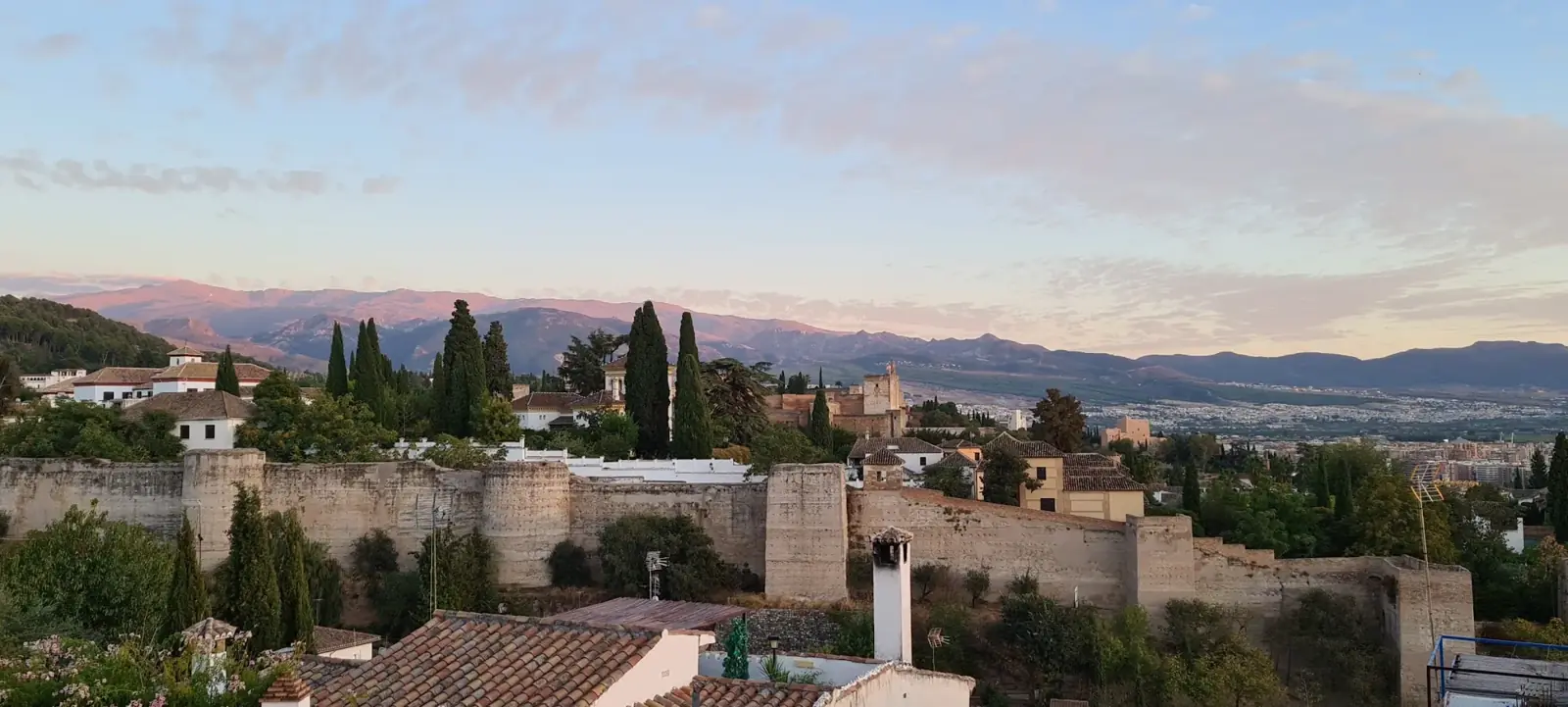
From almost anywhere high in Granada you see the Sierra Nevada, snow-capped for much of the year, standing behind the Alhambra.
The mountains
In winter the Sierra Nevada is a ski area, and in summer its higher slopes are open for hiking, with cool air and big views. Mountain weather changes quickly, so take layers, sun protection and water whatever the season, and check road and weather conditions before you set off. Without a car, organised trips and seasonal buses are the usual ways up; services change with the seasons, so check them in advance.
Day trip to the Alpujarra villages
On the southern side of the mountains lies the Alpujarra, a region of steep valleys, terraced fields, chestnut trees and white villages. The most visited are the three villages of the Poqueira gorge, Pampaneira, Bubión and Capileira, stacked one above the other on the hillside. Their houses have flat roofs, round chimneys and covered passageways, an architecture often linked to the Berber settlers of the area. Further east, Trevélez is known for curing ham in the mountain air.
The Alpujarra is a full day out. The roads are long and winding, and a car makes it far easier to combine villages and stop at viewpoints. Public buses do reach the villages, but services are limited, so check timetables carefully and plan around them. Walking between Pampaneira, Bubión and Capileira on the old paths is a rewarding way to see the gorge, but the climbs are real, so wear proper shoes.
Practical Granada: hills, weather and how many days
Hills and cobbles
If you are arriving from flat Seville, covered in Seville in Slow Motion: Courtyards, Shade and Late Nights, Granada will come as a shock to the legs. The Alhambra, the Albaicín and Sacromonte are all uphill, on uneven cobbles and stone steps. Wear shoes with real grip, as the polished stones can be slippery, especially after rain. If anyone in your group has limited mobility, use the small city buses that climb to the Alhambra and through the Albaicín, take taxis where needed, and plan to walk downhill rather than up. Check how close a taxi can get to your accommodation, as wheeled suitcases are hard work on the cobbles.
Summer heat, winter nights
Granada sits much higher than Seville and the coast, which gives it a sharper climate. Summer days are very hot and dry, so visit the Alhambra and walk the Albaicín early or late, and use the middle of the day for the cathedral, a tea house or a rest. Winter days are often bright and pleasant in the sun, but nights can be properly cold, and snow on the Sierra Nevada is common. Pack a warm layer and check that your accommodation has heating. Spring and autumn are the most comfortable seasons, and also the busiest, which makes early Alhambra booking even more important.
Getting there and around
Granada has a small airport and rail links to Madrid, Seville and other Andalusian cities, so it combines easily with a longer trip around the south. If you are planning a wider route, The Ultimate Guide to Travelling Around Europe covers linking cities by train and air.
How many days
- Two days: one for the Alhambra, one for the Albaicín, Sacromonte and the cathedral quarter, with tapas both evenings. Tight, but it works.
- Three days: the comfortable choice, with time for the Realejo, a slower sunset at San Nicolás and a second look at anything you rushed.
- Four days or more: add a day in the Alpujarra or the Sierra Nevada.
Whatever the length, fix your Alhambra ticket first and plan everything else around the time printed on it.
Official sources and further reading
Opening times, entry rules and prices change, so check them on the official sites before you travel:
- The Alhambra and Generalife (official site): Official ticket sales, visiting rules and the timed entry system for the Nasrid Palaces.
- Spain.info: Spain's official tourism site, with practical information on Andalusia.
- GOV.UK: Spain travel advice: Entry requirements, safety and health advice for British travellers, kept up to date by the UK government.